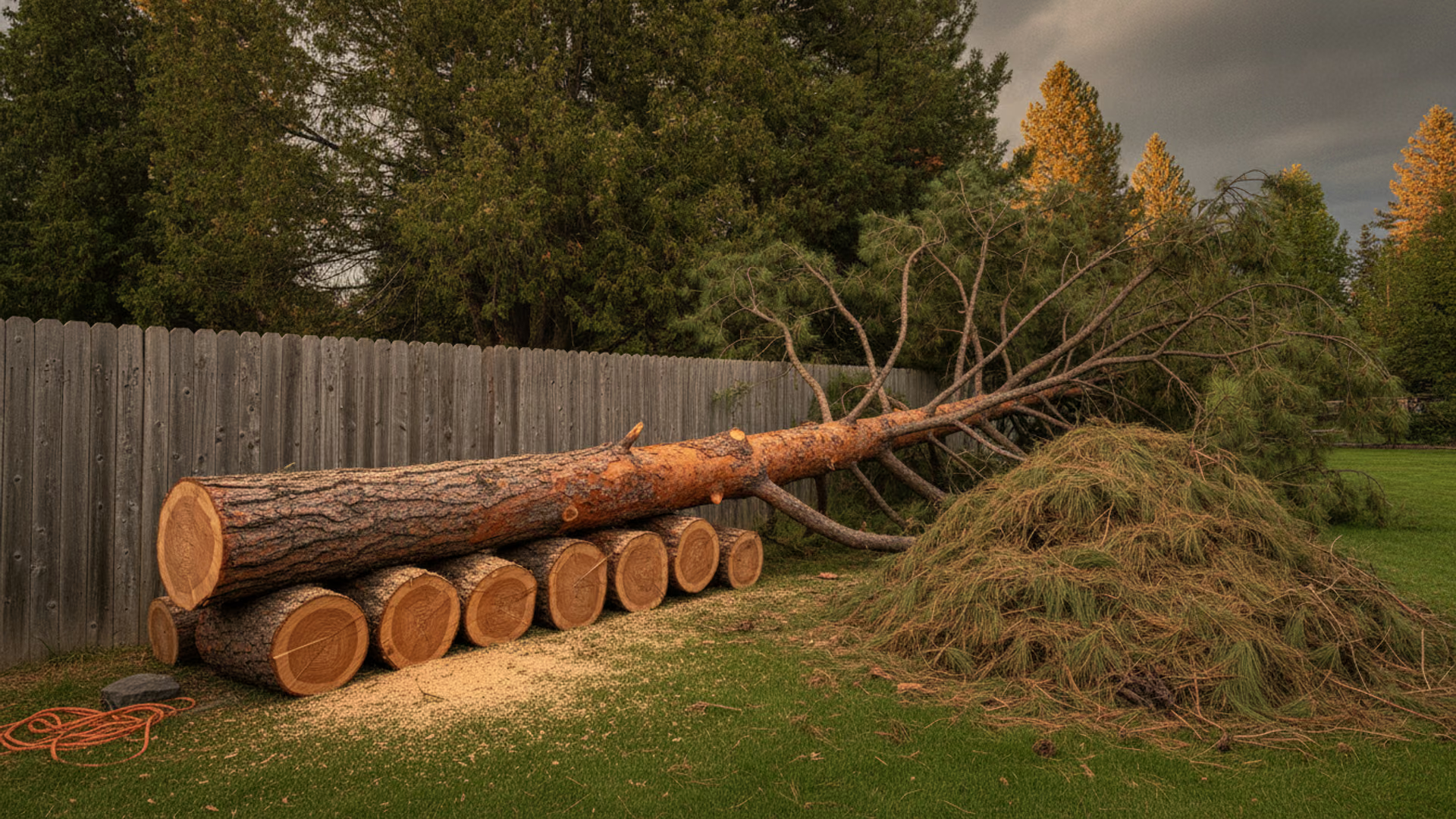
The wind quit an hour ago and there's a ponderosa limb through the fence — or the whole tree is across the driveway, or on the roof, and you're standing in the yard trying to figure out who to call. Call (509) 215-2692. Tree Removal Pros Spokane handles emergency tree removal in Spokane and across Spokane County, and the phone is answered 24 hours a day, 7 days a week — 24/7 storm damage and fallen tree response, residential and commercial. Tell us what fell, what it's resting on, and whether anyone can't get in or out. That's all it takes to get the response moving. And it's the same call whether you typed "tree fell on house Spokane" or "24 hour tree service Spokane" into your phone from the driveway — describe what happened, and the right gear rolls on the first trip.
What counts as a tree emergency
Four situations move to the front of the line:
A tree or limb on a structure. "The tree fell on the house." "A branch went through the garage roof." Anything resting on a roof, wall, carport, or vehicle is an emergency, because the structure is carrying a load it was never designed for — and that load shifts with every gust. Nobody goes into the rooms under it until the weight is off.
Blocked access. A trunk across the driveway, a branch came down on the driveway and pinned the gate shut, a limb across the only road out. If you can't get a vehicle in or out, that's an emergency even when nothing got hit.
A new lean with cracked or mounded soil at the base. That's root-plate movement — the anchoring roots have torn, and a tree that has started to go rarely re-anchors. Keep everyone out from under it and out of its fall path until it comes down.
A hung-up broken limb. Loggers call it a widow-maker: a snapped branch caught in the crown over a roof, driveway, or play area. It falls on the tree's schedule unless a climber brings it down on a rope first.
The honest flip side: a standing dead tree that isn't threatening anything is important, but it's schedulable — that's tree removal, and it's usually cheaper handled as planned daylight work than as a night call.
What to do first (before the crew arrives)
Keep people and pets clear of the tree — and clear of the far side of it. A downed trunk stores enormous tension, and loaded limbs release without warning when weight shifts; the spring is just as dangerous behind the tree as under it. Don't climb onto the roof, and don't try to cut or drag anything off a structure or a vehicle. Pulling a limb free the wrong way is how a dented gutter becomes a hole in the decking.
One rule outranks everything else: if the tree or limb is touching a power line — or any line is down near it — call Avista (or your utility) first, before any tree company. No tree crew works around energized lines, ours included. The utility de-energizes and secures the line; then tree work starts. Any outfit that offers to start cutting next to a live line is one to hang up on.
Once everyone is clear and the electrical side is handled, call (509) 215-2692 and describe what fell, what it's resting on, and what's blocked.
What the response looks like
Emergency work happens in two phases, and keeping them separate is what keeps it safe.
Make-safe comes first. Controlled rigging takes the weight off the structure — nothing free-falls over a roof, fence, or vehicle — the access route gets cleared, the hung limb comes down on a rope, and the site is left stable and tarp-able so repairs and the insurance process can start.
Full removal and cleanup come after. Remaining trunk sections, debris hauling and chipping, and the stump conversation happen once the urgent hazard is gone — scheduled work, in daylight, with a free estimate and no midnight decisions.
Triage is honest: a tree on a house or a blocked driveway moves ahead of yard cleanup, every time. And 24 hour tree service in Spokane means one specific thing here — the phone at (509) 215-2692 gets answered at 2 a.m. It's a working line, not a slogan on a truck door.
Photos before chainsaws — the insurance part
Homeowners insurance typically covers removal when the tree fell on a covered structure — the house, an attached garage, the fence it flattened — and typically does not cover preventive removal of a tree that's still standing. Policies differ, so check yours; that's the general pattern, not a promise. What reliably helps a claim is documentation: photos from several angles before any cutting starts (from the ground — never climb for a picture), and an itemized invoice that separates make-safe work from removal from cleanup, because adjusters handle those line items differently. We photograph the scene and itemize the paperwork exactly that way. And if the tree came off the property next door, the question of who pays when a tree falls on a neighbor's property has a more consistent answer than most people expect — usually the policy covering the property where it landed.
Why Spokane keeps this number saved
Spokane's storm record is the reason this page exists. On November 17, 2015, a windstorm with 71-mph gusts put roughly 1,900 trees down inside Spokane city limits alone — many of them full-grown ponderosas onto houses and power lines — killed two people, and left about 180,000 homes dark in the largest outage in Avista's history. January 2021 repeated the pattern with matching 71-mph gusts. Ice Storm '96 coated the city in up to an inch and a half of freezing rain and damaged some 5,000 of its street and park trees beyond saving. Another damaging windstorm hit in December 2025.
The mechanism is the same every time: 100-foot, shallow-rooted ponderosa pines standing in thin, gravelly soil over basalt. When rain saturates that soil and the wind arrives, whole root plates roll out of the ground — which is why Spokane's signature emergency is an entire pine on a roof, and why the season runs November through January. Between named storms, heavy wet snow keeps snapping limbs all winter. Storm damage tree removal in Spokane is a when, not an if. Save (509) 215-2692 before you need it.
One number across Spokane County
Emergency response runs from the Spokane base across Spokane County and roughly 30 miles out — city lots, Valley streets, and pine-heavy areas like Mead and Fairwood, where the same shallow-rooted ponderosas stand over the same roofs. Storms don't respect city limits, and the response doesn't either. If a tree is down, on something, or blocking your way out, call (509) 215-2692 — day or night. If it can safely wait until morning, request a free estimate and it gets handled as scheduled work, at a scheduled-work pace.